


A roast turkey recipe can feel like a big test. For example, the bird is large, the guests are hungry, and the stakes feel high. This guide takes the stress out of it. You will learn how to pick the right size, thaw it safely, season it well, and roast it until the meat is juicy and the skin is golden. No special tools are needed beyond a roasting pan and a meat thermometer. If this is your first turkey, you are in the right place. Follow the steps in order and you will serve a bird you can be proud of.
Thanksgiving in the United States falls on Thursday, November 26, 2026. That gives you time to plan. In fact, a good roast turkey recipe starts days before the meal, with thawing. It ends with a rest, a carve, and a plate of leftovers. This article covers every stage, with charts in pounds and kilograms, Fahrenheit and Celsius, so readers in the United States, Canada, the United Kingdom, and Australia can all follow along.
What Roasting a Whole Turkey Actually Means
Roasting means cooking a whole bird in the oven with dry heat. The hot air crisps the skin and cooks the meat from the outside in. A roast turkey recipe is not the same as frying or smoking a turkey. For example, frying and smoking have their fans, but roasting is the most common way to cook a holiday bird, and it is the easiest to control at home.
A whole turkey has two types of meat. The breast is lean and dries out fast. The legs and thighs are darker, richer, and more forgiving. Therefore, a good roast balances the two. That balance comes from the right temperature, a thermometer, and a rest after cooking. Brining helps too, and we cover that below.
Most turkeys sold for Thanksgiving weigh between 10 and 20 pounds, or about 4.5 to 9 kilograms. A fresh turkey has never been frozen. On the other hand, a frozen turkey is cheaper and easier to find, but it needs days to thaw in the fridge. Either type works well in this roast turkey recipe. Choose the one that fits your schedule.
How Much Turkey Do You Need for Your Roast Turkey Recipe?
Plan on about 1 to 1.5 pounds of turkey per person, or 450 to 680 grams per person. That amount covers a generous serving plus leftovers. If your guests are light eaters or you have many side dishes, aim for the lower end. If you want plenty of leftovers for sandwiches, aim for the higher end. In addition, a larger bird also feeds more people with less waste, because the bone to meat ratio improves as the bird gets bigger.
| Turkey weight | Serves | With leftovers |
|---|---|---|
| 8 to 10 lb (3.6 to 4.5 kg) | 6 to 8 | 4 to 6 |
| 10 to 12 lb (4.5 to 5.4 kg) | 8 to 10 | 6 to 8 |
| 12 to 14 lb (5.4 to 6.4 kg) | 10 to 12 | 8 to 10 |
| 14 to 16 lb (6.4 to 7.3 kg) | 12 to 14 | 10 to 12 |
| 16 to 18 lb (7.3 to 8.2 kg) | 14 to 16 | 12 to 14 |
| 18 to 20 lb (8.2 to 9.1 kg) | 16 to 20 | 14 to 16 |
| 20 to 24 lb (9.1 to 10.9 kg) | 20 to 24 | 16 to 20 |
If your oven is small, check that the bird fits before you buy it. A very large turkey can also cook unevenly, with dry breast meat by the time the legs finish. In fact, two smaller birds often cook better than one giant bird. Keep that in mind if you are feeding a crowd.
How to Thaw a Turkey for Your Roast Turkey Recipe
Thawing is the step people forget, and it is the step that causes the most trouble. A frozen turkey must thaw fully before it roasts. The only safe way to thaw a whole turkey is in the fridge. However, cold water thawing works in a pinch, but it needs constant attention. Never thaw a turkey on the kitchen counter. Bacteria grow fast at room temperature, and the outside of the bird will warm up long before the inside thaws.
Allow about 24 hours of fridge thawing for every 4 to 5 pounds of turkey, or every 1.8 to 2.3 kilograms. For example, a 12 pound bird needs about three days. A 20 pound bird needs about five days. Start thawing earlier than you think you need to. A thawed turkey keeps safely in the fridge for one or two days before cooking, so an extra day costs you nothing.
| Turkey weight | Fridge thawing time |
|---|---|
| 4 to 8 lb (1.8 to 3.6 kg) | 1 to 2 days |
| 8 to 12 lb (3.6 to 5.4 kg) | 2 to 3 days |
| 12 to 16 lb (5.4 to 7.3 kg) | 3 to 4 days |
| 16 to 20 lb (7.3 to 9.1 kg) | 4 to 5 days |
| 20 to 24 lb (9.1 to 10.9 kg) | 5 to 6 days |
Place the turkey on a tray or in a roasting pan while it thaws. Juices can leak, and the tray catches them. Keep the bird in its wrapper until you are ready to prep it. If you need a faster thaw, use the cold water method. Next, submerge the wrapped turkey in cold tap water and change the water every 30 minutes. Allow about 30 minutes per pound, or about 65 minutes per kilogram. Cook the bird right after a cold water thaw.
Dry Brine or Wet Brine for a Roast Turkey Recipe?
Brining seasons the meat from the inside out and helps it hold moisture. A wet brine soaks the turkey in salty water. A dry brine rubs salt over the skin and lets it rest in the fridge. Both work well. In fact, a dry brine is easier for most home cooks. It needs no huge container, no gallons of water, and no fridge space for a bucket. It also gives you crispier skin.
For a dry brine, use about 1 tablespoon of kosher salt for every 4 pounds of turkey, or about 15 grams per 1.8 kilograms. Rub the salt over the whole bird, inside and out. Then, place the turkey on a rack in a pan, uncovered, in the fridge for 24 to 48 hours. The salt draws out moisture, dissolves in it, and then soaks back in. The skin dries out in the fridge, and dry skin crisps beautifully in the oven.
For a full step by step guide to brining, including exact salt amounts and timing, read our guide on how to brine a turkey. It covers both methods in detail. Whichever brine you choose, do not add extra salt to the seasoning later. The brine already seasoned the bird. Taste your gravy before salting it too, since pan drippings can be salty.
Seasoning and Prep Steps for a Roast Turkey Recipe
First, take the turkey out of the fridge about 45 minutes before roasting. Letting it warm slightly helps it cook more evenly. Remove the neck and giblets from the cavities and save them for stock or gravy. Pat the bird dry inside and out with paper towels. In fact, dry skin is the secret to golden, crisp skin. Wet skin steams instead of roasting.
You will need a few simple ingredients. The list below seasons a 12 to 14 pound turkey. Scale it up or down for your bird. Keep the flavors simple. Turkey tastes best when the seasoning supports it instead of hiding it.
What You Need to Season the Turkey
- 1 whole turkey, thawed, neck and giblets removed
- 3 to 4 tablespoons of olive oil or softened unsalted butter (45 to 60 ml oil, or 45 to 60 g butter)
- 2 teaspoons of dried thyme (or 1 tablespoon fresh)
- 2 teaspoons of dried sage (or 1 tablespoon fresh)
- 1 teaspoon of garlic powder
- 1 teaspoon of black pepper
- 1 lemon, halved
- 1 onion, quartered
- 4 sprigs of fresh rosemary or thyme
- 1 cup of low sodium chicken stock or water (240 ml) for the pan
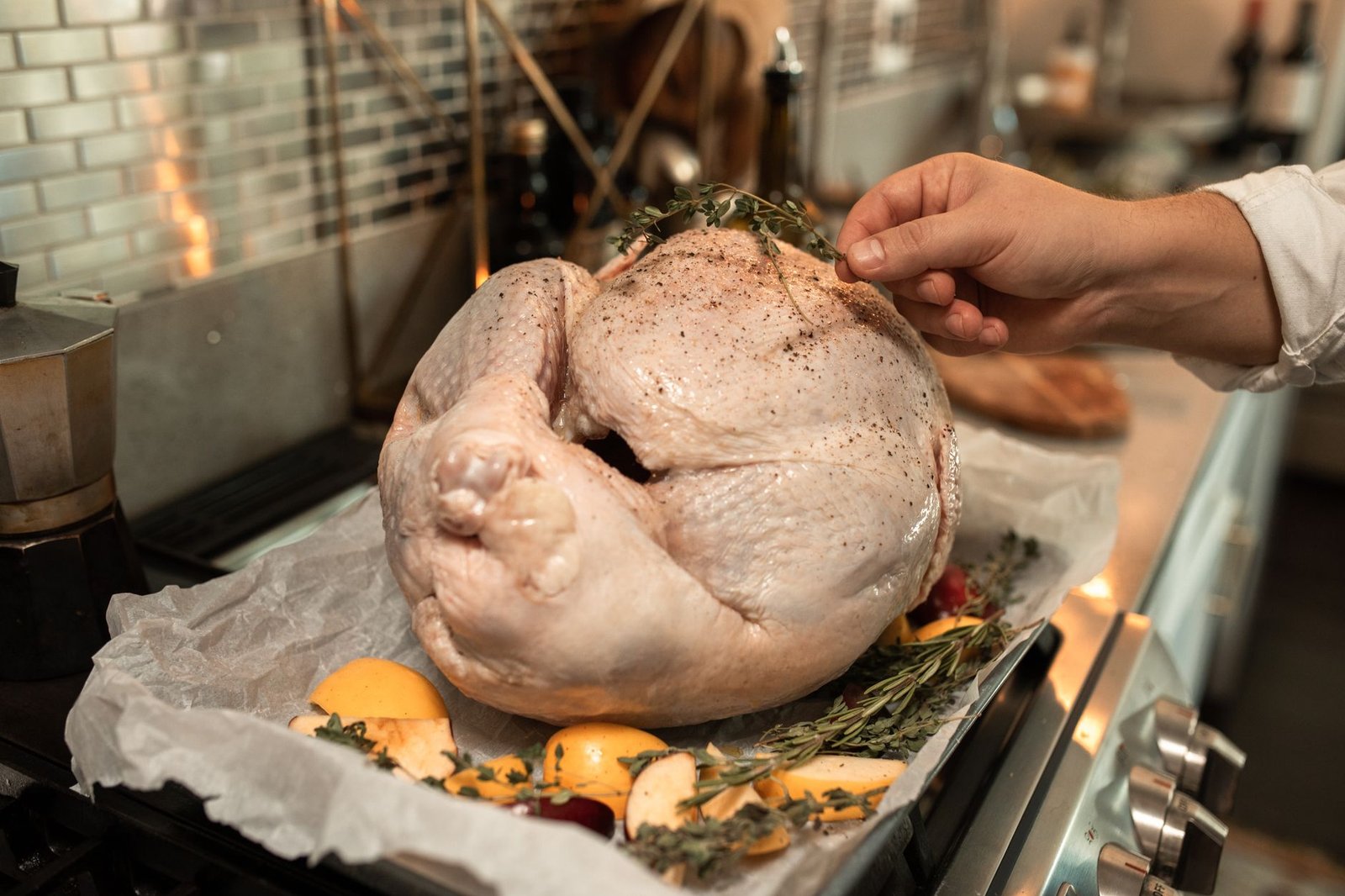
Rub the oil or butter all over the skin. Next, mix the herbs, garlic powder, and pepper together and rub the mix over the bird. Place the lemon, onion, and herb sprigs inside the cavity. These aromatics steam gently as the turkey roasts and perfume the meat. Tuck the wing tips under the body so they do not burn. Finally, tie the legs together with kitchen string. This helps the bird cook evenly and look tidy on the table.
Place the turkey breast side up on a rack in a roasting pan. Then, pour the stock or water into the pan. The liquid keeps the drippings from burning and gives you a base for gravy later. If you do not have a rack, use a bed of thickly sliced onion and carrot. In fact, that works just as well and adds flavor to the drippings.
Roast Turkey Recipe Temperatures and Times
Roast at 325 degrees Fahrenheit, or 165 degrees Celsius, for most of the cook. This steady heat cooks the bird through without drying the breast. For example, some cooks start hotter, at 425 F or 220 C, for the first 30 minutes to crisp the skin, then drop the heat to 325 F. Both approaches work. However, pick one and stick with it. Opening the oven door to check often lets heat escape and slows the cook.
Times depend on weight and on whether the bird is stuffed. In fact, an unstuffed turkey cooks faster. We recommend cooking stuffing in a separate dish, not inside the bird. Stuffing inside a turkey must reach 165 F itself, and by the time it does, the breast is often overcooked. As a result, our stuffing recipe bakes in its own dish and turns out golden and crisp on top.
| Turkey weight, unstuffed | Time at 325 F (165 C) | Time if stuffed |
|---|---|---|
| 8 to 12 lb (3.6 to 5.4 kg) | 2.75 to 3 hours | 3 to 3.5 hours |
| 12 to 14 lb (5.4 to 6.4 kg) | 3 to 3.75 hours | 3.75 to 4.25 hours |
| 14 to 18 lb (6.4 to 8.2 kg) | 3.75 to 4.25 hours | 4.25 to 4.75 hours |
| 18 to 20 lb (8.2 to 9.1 kg) | 4.25 to 4.5 hours | 4.5 to 5 hours |
| 20 to 24 lb (9.1 to 10.9 kg) | 4.5 to 5 hours | 5 to 5.25 hours |
These times are guides, not guarantees. Ovens vary, and a cold bird takes longer than a room temperature bird. However, always check doneness with a thermometer. If the skin browns too fast, tent the breast loosely with foil. The foil slows browning without stopping the cook. Finally, remove the foil for the last 30 minutes so the skin crisps again.
How to Check Doneness in a Roast Turkey Recipe
A meat thermometer is the only reliable way to know a turkey is done. Color is not a guide. For example, juices can run clear before the meat is safe, and pink meat near the bone can be safe if the temperature is right. Use an instant read thermometer and check three places. The thickest part of the breast should read 165 F, or 74 C. In fact, the thickest part of the thigh, away from the bone, should read 175 to 180 F, or 80 to 82 C. The wing joint should read at least 165 F, or 74 C.
Insert the thermometer into the thickest part of the meat and keep it away from bone. Bone conducts heat and gives a false high reading. Check in more than one spot. If one area lags behind, give the bird more time and check again in 15 minutes. The safe minimum internal temperature for turkey is 165 F, or 74 C, according to the FoodSafety.gov safe minimum internal temperatures chart. That temperature applies to the whole bird, including any stuffing cooked inside it. You can read the full chart on the FoodSafety.gov safe minimum internal temperatures chart.
Take the turkey out of the oven when the breast reads 160 to 162 F, or about 71 to 72 C. The temperature rises by 3 to 5 degrees during the rest. As a result, this carryover cooking finishes the bird without drying it out. Do not skip the rest. In fact, it matters as much as the roasting itself.
Resting Your Roast Turkey Recipe
Rest the turkey for at least 20 minutes, and 30 to 40 minutes for a large bird. Tent it loosely with foil and leave it on the carving board. In fact, the juices settle back into the meat during the rest. Cut into a turkey straight from the oven and the juices run onto the board. As a result, wait, and those juices stay in the meat where they belong.
Use the resting time well. Make the gravy from the pan drippings. Next, warm the side dishes. Finally, set the table. A rested turkey also carves more cleanly, so the slices hold together instead of falling apart. The bird stays hot under the foil tent for the full rest, so do not worry about it cooling down.
How to Carve Your Roast Turkey
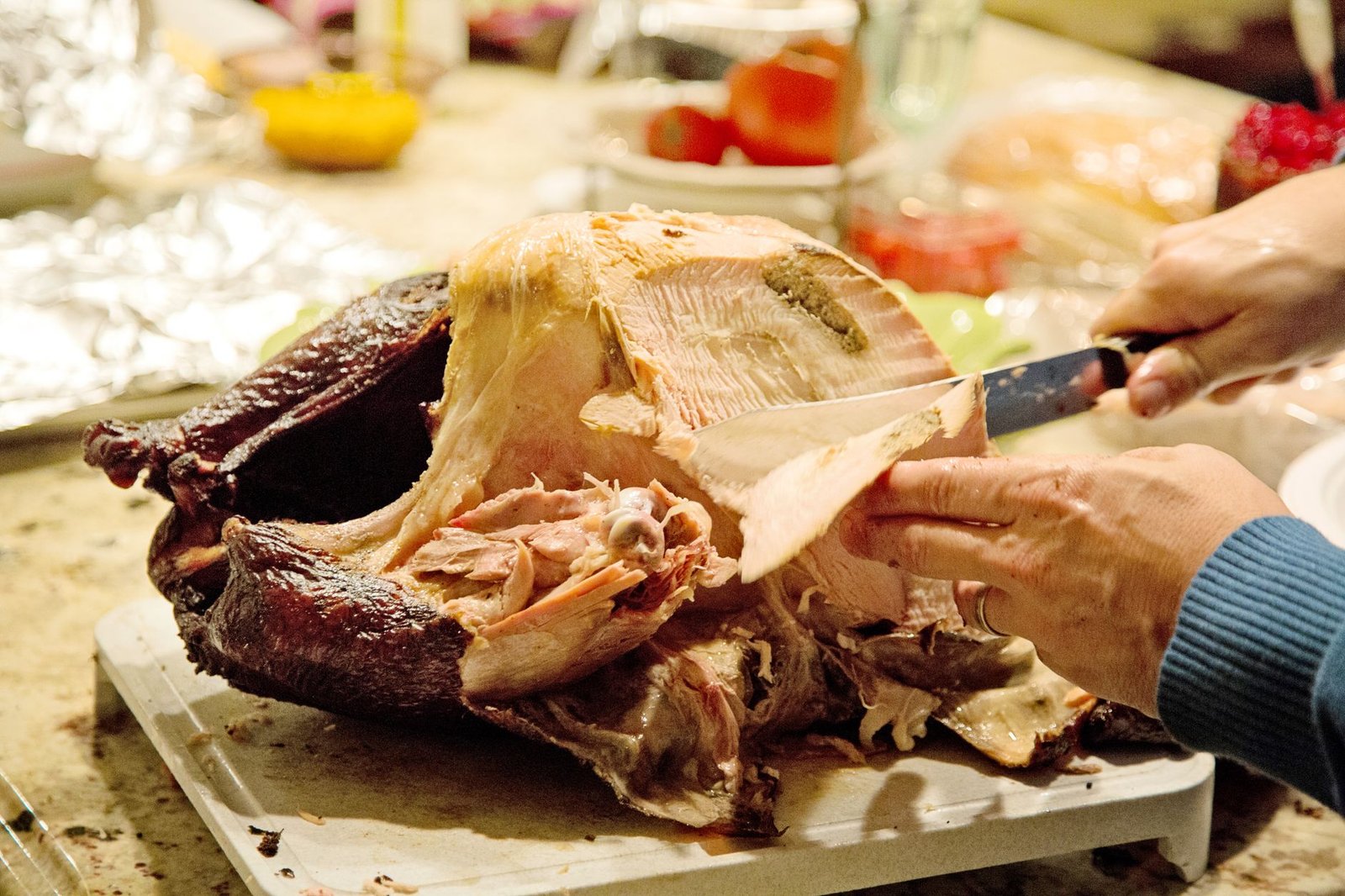
Carving looks hard, but it follows the joints. Work with a sharp carving knife and a large fork. In fact, a dull knife tears the meat. Start by removing the legs. Cut through the skin between the leg and the body, then bend the leg outward until the joint pops. Cut through the joint to free the leg. Then, separate the drumstick from the thigh at the joint. Slice the thigh meat off the bone.
Next, remove the wings in the same way. Cut through the skin, bend the wing outward, and cut through the joint. Then slice the breast. Run the knife along one side of the breastbone, from top to bottom, and lift the whole breast half off the bone. Slice it across the grain into even pieces about half an inch thick, or about 1 cm thick. Repeat on the other side.
Arrange the slices on a warm platter, with dark meat on one side and white meat on the other. Pour a little warm stock or a spoonful of pan juices over the sliced meat to keep it moist. Finally, save the carcass for stock. In fact, it makes a rich soup base and stretches your Thanksgiving cooking into the weekend.
Gravy and Leftovers for Your Roast Turkey Recipe
Gravy turns a good turkey into a great meal. Use the pan drippings as your base. Pour the drippings into a jug, let the fat rise, and skim most of it off. Whisk the remaining drippings with flour or cornstarch and stock in a saucepan until smooth. Simmer until thick, then season to taste. Our turkey gravy recipe walks through the full method, including how to fix lumpy gravy and how to make it ahead.
Leftovers are half the joy of a roast turkey. Refrigerate leftover meat within two hours of serving. Slice it off the bone before storing it, and pack it in shallow containers so it cools fast. Leftover turkey keeps for three to four days in the fridge. In addition, freeze what you will not eat in that time, in portions you can defrost one at a time. Finally, reheat leftovers to 165 F, or 74 C, before eating.
Plan the rest of the table around the bird. Our guide to Thanksgiving side dishes covers the classics, from mashed potatoes to green beans. A golden stuffing recipe baked in its own dish belongs on every Thanksgiving table. For dessert, a silky pumpkin pie recipe or a rich pecan pie recipe finishes the meal. Each one is simple to make ahead, so the day itself stays calm.
Common Mistakes in a Roast Turkey Recipe
- Skipping the thaw. A partly frozen turkey cooks unevenly and stays raw in the middle.
- Washing the turkey. Rinsing spreads bacteria around the sink. Patting the bird dry is enough.
- Skipping the thermometer. Time charts are guides, and only a thermometer proves the bird is done.
- Opening the oven too often. Each peek drops the temperature and adds cooking time.
- Stuffing the bird. Stuffing inside the turkey slows the cook and dries the breast. Bake it separately.
- Skipping the rest. Cutting too soon spills the juices and dries the meat.
- Salting twice. A brined turkey is already seasoned. Taste before you add more salt.
- Overcooking the breast. Take the bird out at 160 to 162 F and let carryover cooking finish it.
Frequently Asked Questions
How long does it take to roast a turkey?
A 12 to 14 pound turkey takes about 3 to 3.75 hours at 325 F, or 165 C, unstuffed. Larger birds take longer. Always confirm doneness with a thermometer instead of trusting the clock alone.
What temperature should a roast turkey reach?
The breast should reach 165 F, or 74 C. The thigh should reach 175 to 180 F, or 80 to 82 C. Take the bird out when the breast reads 160 to 162 F and let the rest carry it to the safe temperature.
Do I need to brine my turkey?
You do not have to brine, but brining helps. A dry brine adds flavor and helps the meat stay juicy. If you are short on time, a well seasoned and properly rested turkey still turns out well.
Can I roast a turkey the day before Thanksgiving?
Yes. Roast it, rest it, carve it, and refrigerate the sliced meat in its juices. Reheat it gently in a covered dish at 325 F with a splash of stock until it reaches 165 F. The texture stays good, and the day itself is far calmer.
How do I keep turkey moist after carving?
Slice only what you need, keep the rest in larger pieces, and spoon warm pan juices or stock over the slices. Cover the platter loosely with foil while it waits on the table.
What should I do with leftover turkey?
Refrigerate it within two hours and use it within three to four days. It works well in sandwiches, soups, salads, and curries. Freeze portions you will not eat in time, and reheat them to 165 F, or 74 C.
A Juicy Finish, Every Time
A great roast turkey recipe is really a short list of habits. Thaw in the fridge. Season simply. Roast at a steady heat. Check the temperature. Rest the bird. Carve with care. In short, none of these steps is hard on its own. As a result, they give you a golden, juicy turkey that feeds a crowd and leaves plenty for leftovers.
Thanksgiving is about the people at the table as much as the food on it. A calm cook makes a calm host. Plan ahead, trust the thermometer, and enjoy the meal. After all, your first turkey can be a great one. In fact, this roast turkey recipe will get you there.
This article is general information for home cooks. It is not medical or professional food safety advice. Always follow current food safety guidance and check your turkey with a thermometer before serving.

 Ablaze Fitness


