


This beginner strength training plan is one of the most useful habits a beginner can build. For example, it helps you carry groceries, climb stairs, play with your kids, and move through daily life with more confidence. It does not require a perfect gym, a complicated program, or heavy weights on day one.
This beginner strength training plan uses three full body days a week. Each session works your legs, upper body, and core. Also, you can follow it at home, in a gym, or with a mix of both. The plan is designed to be repeated, tracked, and progressed slowly, so you get stronger without feeling overwhelmed.
This article is for general fitness information only. However, it is not medical advice. If you have a health condition, an injury, or you are unsure whether strength training is safe for you, talk to a qualified health professional first. For general guidance, also see the World Health Organization physical activity fact sheet.
Who this beginner strength training plan is for
This plan fits you if:
- You are new to strength training, or you have not trained consistently in a long time
- You want a simple routine you can follow three days a week
- You train at home, in a gym, or in both places during the week
- You want strength for everyday life, not just for looking a certain way
You do not need to be strong to start strength training. In fact, strength is the result of the plan, not a requirement for it.
Why three full body days work in a beginner strength training plan
Many beginners worry that they need to train every day, or split their body into separate days for arms, legs, and chest. For most beginners, however, that is more complex than helpful.
Three full body days work well because:
- You practice the main movements often enough to learn them well
- Each muscle group gets rest between sessions
- You have four rest or light activity days each week
- The plan is easier to fit around work, family, and travel
A typical week looks like this: train Monday, Wednesday, and Friday, and rest or walk on the other days. If your schedule is different, keep at least one rest day between strength sessions when you can. The exact days matter less than the pattern.
The main movements in this beginner strength training plan
This plan is built around six movement patterns. Also, learning these patterns gives you a foundation for almost any later program.
- Squat: bending your knees and hips to lower your body, then standing back up.
- Hinge: pushing your hips back, like a deadlift or a hip hinge, while keeping your back flat.
- Push: pressing weight away from your body, like a push-up or a dumbbell press.
- Pull: pulling weight toward your body, like a row.
- Carry: walking while holding weight, which builds grip, core, and posture.
- Core: controlled movements that keep your trunk stable, like a plank or a dead bug.
You do not need to master all six in week one. You need to practice them with light effort, good form, and steady progress.
Home and gym options in a beginner strength training plan
This beginner strength training plan is written so you can use it in either setting. The movement is the same. Only the tool changes.
| Movement | Home option, no gym | Home option, basic equipment | Gym option |
|---|---|---|---|
| Squat | Bodyweight squat, goblet squat holding a household item | Goblet squat with a dumbbell or kettlebell | Goblet squat, leg press, or barbell squat with light weight and good coaching |
| Hinge | Glute bridge, single leg glute bridge | Romanian deadlift with dumbbells | Romanian deadlift with a barbell or dumbbells |
| Push | Wall push-up, knee push-up, full push-up | Dumbbell floor press or dumbbell shoulder press | Machine chest press, dumbbell press, or barbell press with light weight |
| Pull | Towel row using a sturdy door anchor only if it is safe, or a backpack row | One arm dumbbell row | Seated cable row, machine row, or dumbbell row |
| Carry | Farmer carry with grocery bags or water jugs, for short distances | Farmer carry with dumbbells | Farmer carry with dumbbells or kettlebells |
| Core | Dead bug, bird dog, plank | Dead bug, plank, Pallof press with a band | Dead bug, plank, Pallof press with a cable |
If you train at home, start with bodyweight and household items, and add dumbbells or resistance bands later if you want to. If you train in a gym, start with machines and light dumbbells, and ask staff for a form check on your first visit if that help is available. Do not feel pressure to use a barbell in week one. A barbell is a tool, not a test.
The 3 day beginner strength training plan
First, do this plan three days a week. Each session should take 35 to 50 minutes, including warm-up and cool-down. Then, rest 60 to 90 seconds between sets at first, and 45 to 60 seconds later as you get fitter.
First, warm up for 5 to 10 minutes before every session: march in place, arm circles, hip circles, slow bodyweight squats, and gentle walking lunges.
First session: Full body A
- Squat: 3 sets of 8 to 12 reps
- Push: 3 sets of 8 to 12 reps, using your push-up or press variation
- Pull: 3 sets of 10 to 12 reps, using your row variation
- Glute bridge or hinge: 2 sets of 12 to 15 reps
- Core: dead bug, 2 sets of 8 reps each side
- Carry: 2 walks of 30 to 45 seconds, with a comfortable weight
Second session: Full body B
- Hinge: 3 sets of 8 to 12 reps
- Push: 3 sets of 8 to 12 reps, using a different push variation if you can, for example a shoulder press instead of a chest press
- Pull: 3 sets of 10 to 12 reps
- Squat: 2 sets of 10 to 12 reps, at an easier effort than Day 1
- Core: plank, 2 holds of 20 to 40 seconds, with good form
- Carry: 2 walks of 30 to 45 seconds
Third session: Full body A or B, your choice
Also, repeat Day 1 or Day 2, whichever felt better, and try to add a small amount of progress. For example, add one rep to one exercise, add one set to one exercise, or use a slightly heavier household item or dumbbell for one exercise. You do not need to progress on every exercise every week.
Finally, cool down for 5 minutes after every session: gentle stretching for thighs, hamstrings, chest, shoulders, and hips, plus slow deep breathing.
How to choose the right effort in a beginner strength training plan
Beginners often ask how heavy the weight should be. A useful guide is the last two reps rule. The last two reps of a set should feel challenging, but you should still be able to finish them with good form. If you can finish a set and feel like you could easily do ten more reps, the effort is too light. If your form breaks down halfway through, the effort is too heavy.
For bodyweight moves, change the variation instead of adding weight. Wall push-ups lead to knee push-ups, which lead to full push-ups. Bodyweight squats lead to goblet squats, which lead to heavier goblet squats. Small steps in difficulty are still progress.
Progression over 8 weeks in a beginner strength training plan
Strength builds slowly, and that is normal. Therefore, use this simple progression as a guide, not a strict rule.
Weeks 1 to 2: Learn the movements. Use 2 sets per exercise if 3 sets feel like too much. Focus on form, steady breathing, and a comfortable effort. Write down what you did.
Weeks 3 to 4: Use 3 sets for most exercises. Add 1 to 2 reps per set when the last set feels easy. Shorten rest slightly if you feel ready.
Weeks 5 to 6: Add a slightly heavier variation for one or two exercises. For example, move from a knee push-up to a full push-up for the first set only, then finish the other sets with knee push-ups. Or add a light dumbbell to your goblet squat.
Weeks 7 to 8: Repeat weeks 5 to 6, and review your notes. You should see clear progress in reps, sets, weight, or ease. At this point, you can repeat the plan with harder variations, add a fourth day if your recovery is good, or move to a more advanced beginner program.
If progress stalls for two weeks, do not panic. Check the basics first: Are you sleeping enough? Is your training consistent? Are you resting enough between sessions? Do you eat regular meals? Often, one of those basics explains a plateau better than the workout itself.
Form cues that prevent common mistakes in a beginner strength training plan
Squat
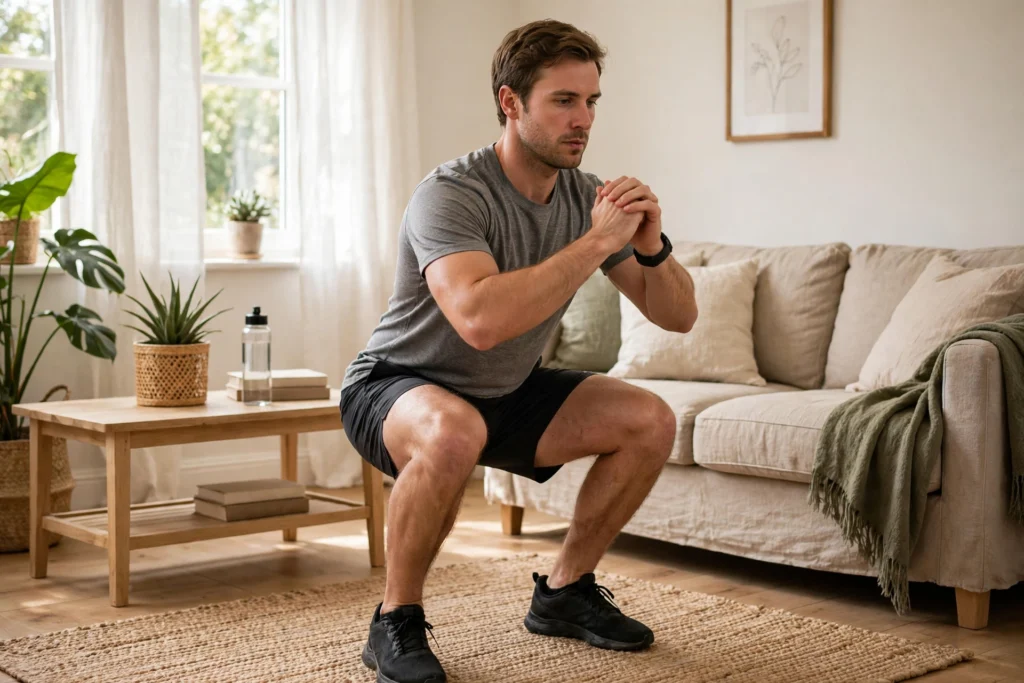
Keep your chest up, your feet flat, and your knees moving in the same direction as your toes. Sit back and down, rather than letting your knees travel far forward and your heels lift. Go only as low as you can while keeping your back flat and your heels down.
Hinge
Push your hips back, keep your back flat, and feel a stretch in your hamstrings. Your knees should bend slightly, but this is not a squat. Think of closing a car door with your hips. If you feel sharp pulling in your lower back, stop, reduce the range, and use a lighter effort.
Push
For a push-up, keep a straight line from head to heels or head to knees, and lower with control. For a dumbbell press, keep your wrists straight and lower the weights slowly. Do not let your elbows flare out sharply, and do not arch your lower back to lift more.
Pull

For a row, pull your elbow back toward your hip, squeeze your shoulder blade gently, and lower with control. Do not shrug your shoulders up toward your ears, and do not twist your trunk to lift the weight.
Carry
Stand tall, keep your shoulders level, and walk with short, steady steps. If you lean to one side, the weight is too heavy or the distance is too long. Start with a short distance and build up.
Core
For a plank, keep your hips level, your ribs down, and your breathing steady. A shorter plank with good form is better than a long plank with sagging hips. For a dead bug, keep your lower back gently pressed into the floor, and do not lower your limbs so far that your back arches.
Rest days in a beginner strength training plan
Rest days are part of the plan, not days off from health. In addition, on rest days, you can:
- Walk at a comfortable pace for 20 to 40 minutes
- Do gentle stretching or mobility work for 10 to 15 minutes
- Do light household activity, gardening, or play
- Focus on sleep and regular meals
Avoid turning every rest day into a hard workout. Recovery is when your body adapts to training, and skipping recovery often leads to tiredness, soreness, and loss of motivation.
Common beginner mistakes to avoid
- Starting too heavy. Heavy weights with poor form teach bad habits and increase the risk of strain.
- Skipping the warm-up. Cold muscles and stiff joints make training feel harder and less safe.
- Training the same muscles hard every day. Muscles need rest between hard sessions.
- Copying an advanced program from social media. A program built for an experienced lifter is not a beginner program, even if it looks simple.
- Ignoring pain. Mild muscle soreness after a new workout is common. Sharp pain, joint pain, or pain that gets worse over several days is different. Ease off and seek professional advice if you are concerned.
- Quitting after a missed week. Life happens. Return to the last comfortable version of the plan, not the hardest version you ever did, and build back up.
How to track your sessions in a beginner strength training plan
A simple notebook or phone note works well. For each session, record:
- Date and session, Day 1 or Day 2
- Exercise, variation, sets, reps, and weight or household item used
- How hard it felt, on a scale of 1 to 10
- Any notes about form, balance, or discomfort
Review your notes every two weeks. Progress is often easier to see in writing than in the mirror. If you can do more reps, more sets, a harder variation, or the same work with less effort, you are getting stronger.
Strength training and everyday life in the US, UK, and Canada
The plan is the same in all three countries, but a few practical notes help.
In the US, gyms often use pounds. Meanwhile, in the UK and Canada, kilograms are common, and Canada also uses pounds in many gyms. When you track your weights, write the unit you used, so your notes stay clear.
In the UK, a gym is often called a leisure centre or a fitness centre. By contrast, in the US and Canada, it is often called a gym or a fitness center. The equipment is similar, even if the names differ.
If you train at home in a small flat or apartment, choose quiet, low impact variations first, like goblet squats, glute bridges, and rows, and be mindful of neighbours below you when you do carries or step work.
For winter training outdoors in Canada or the northern US, warm up indoors first. In a hot climate in the southern US, train in a cooler part of the day, keep water close, and take extra rest if you feel overheated.
Frequently asked questions
How many days a week should a beginner do strength training?
Three days a week is a good starting point for most beginners. It gives you enough practice to learn and progress, with rest days for recovery. Two days a week can also work if your schedule is tight, and four days can work later if your recovery is good.
Do I need a gym to get stronger?
No. Bodyweight training, household items, resistance bands, and dumbbells can build strength for beginners. A gym gives you more equipment choices and heavier weights later, but it is not required to start.
How long should a beginner strength session take?
About 35 to 50 minutes, including warm-up and cool-down, is enough for this plan. Longer sessions are not automatically better, especially when you are learning new movements.
Should I feel sore after every session?
Not necessarily. Mild soreness after a new workout is common, but soreness is not a reliable measure of a good workout. Steady progress in reps, sets, or weight is a better measure.
What if I cannot do a push-up or a squat well yet?
Start with an easier variation. Wall push-ups lead to knee push-ups, which lead to full push-ups. A shallow squat with a chair for support can lead to a deeper bodyweight squat over time. Easier variations are not cheating. They are how beginners build strength safely.
Is strength training safe for older beginners?
Many older adults strength train safely, and it can support balance, bone health, and everyday independence in general terms. That said, this is general information only. If you have a health condition, a history of falls, or you take medication that affects exercise, talk to a qualified health professional before starting, and consider a qualified coach for your first sessions.
Can I combine this plan with walking or running?
Yes. Walking on rest days works well with this plan. If you also run, keep running easy at first, and avoid adding hard running and hard strength training on the same day while you are still building the habit.
How long until I see results?
Most beginners notice better coordination and confidence within a few weeks, and measurable strength gains within 4 to 8 weeks. Visible body changes usually take longer, and they depend on sleep, nutrition, activity, and consistency, not just the workout.
The bottom line
You do not need a complicated program to get stronger. You need three full body days, six basic movements, good form, and steady progress.
Start light, track what you do, rest between sessions, and add a little difficulty every week or two. That simple pattern, repeated for eight weeks, is a real beginner strength training plan, and it is a strong foundation for whatever you do next.
Disclaimer: This content is for general fitness information only and is not a substitute for professional medical, fitness, or nutrition advice.

 Ablaze Fitness


 Mélanie Courcelles


