

Starting a beginner home workout plan with no equipment does not need a gym membership or a perfect schedule. It needs a plan you can actually repeat.
This beginner home workout plan needs no equipment and uses only your body weight. Each session takes 20 to 30 minutes, including warm-up and cool-down. You will train 3 to 4 days a week, build strength gradually, and learn the basic movements that most fitness programs are built on.
If you are new to exercise, returning after a long break, or short on time, this is a good place to start.
This article is for general fitness information only. It is not medical advice. If you have a health condition, an injury, or you are unsure whether exercise is safe for you, talk to a qualified health professional first.
Who this beginner home workout plan is for
This plan fits you if:
- You are a beginner, or you have not trained consistently in months
- You want to work out at home, with no equipment
- You can set aside 20 to 30 minutes, 3 to 4 times a week
- You want strength, stamina, and better movement, not just a quick burn
You do not need to be fit to start. The plan is designed to meet you where you are, then progress slowly.
How this 4-week beginner home workout plan works
Each week has the same simple structure, with a small increase in effort:
- Day 1: Full body strength
- Day 2: Rest or gentle walking
- Day 3: Full body strength, with a cardio finish
- Day 4: Rest or gentle walking
- Day 5: Full body strength, or a mobility and core session
- Days 6 and 7: Rest, walking, or light stretching
Aim for 2 to 3 sets of each exercise at first. Rest 45 to 60 seconds between sets. If an exercise feels too hard, do fewer reps with good form rather than more reps with poor form.
A simple way to progress in your beginner home workout plan
- Week 1: Learn the movements. Use the lower rep range. Focus on form.
- Week 2: Add 1 set to your main exercises, or add 2 reps per set.
- Week 3: Shorten rest to 30 to 45 seconds, or add a fourth training day.
- Week 4: Repeat Week 3, but try the harder variation of one exercise per session, for example knee push-ups to full push-ups for some sets.
Progress does not need to be dramatic. Small, steady increases are how beginners build lasting strength.
Warm-up: 5 minutes
Do this before every session:
- March in place, 1 minute
- Arm circles, 30 seconds each way
- Hip circles, 30 seconds each way
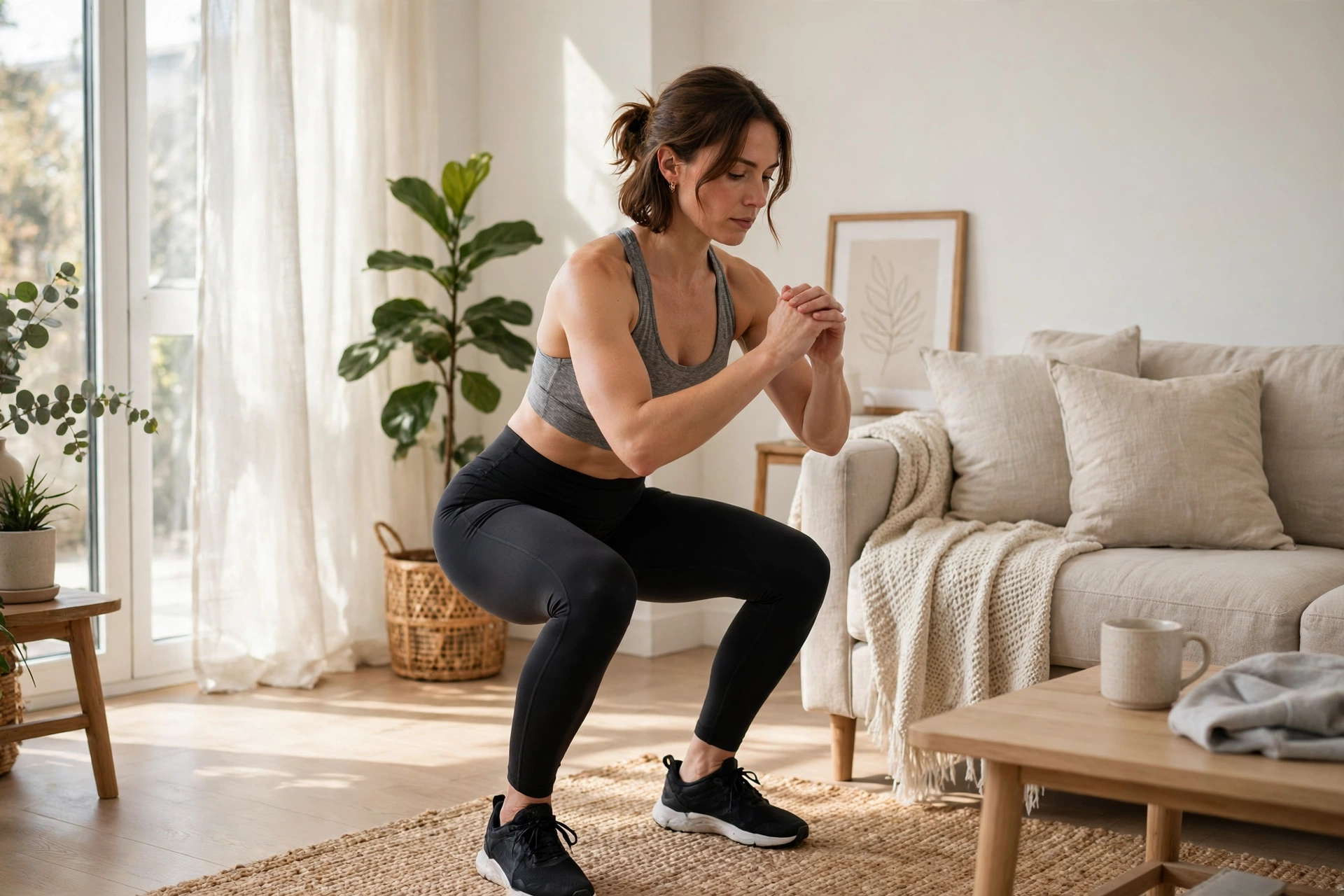
- Bodyweight squats, slow, 10 reps
- Walking lunges or step-backs, 10 total reps
You should feel warm and slightly out of breath, not tired, before the main workout starts.
The core workout: a beginner home workout plan with no equipment
Do this circuit 2 to 3 times, resting 60 seconds between rounds.
- Bodyweight squats: 10 to 15 reps. Keep your chest up, knees tracking over your toes, and weight in your mid-foot.
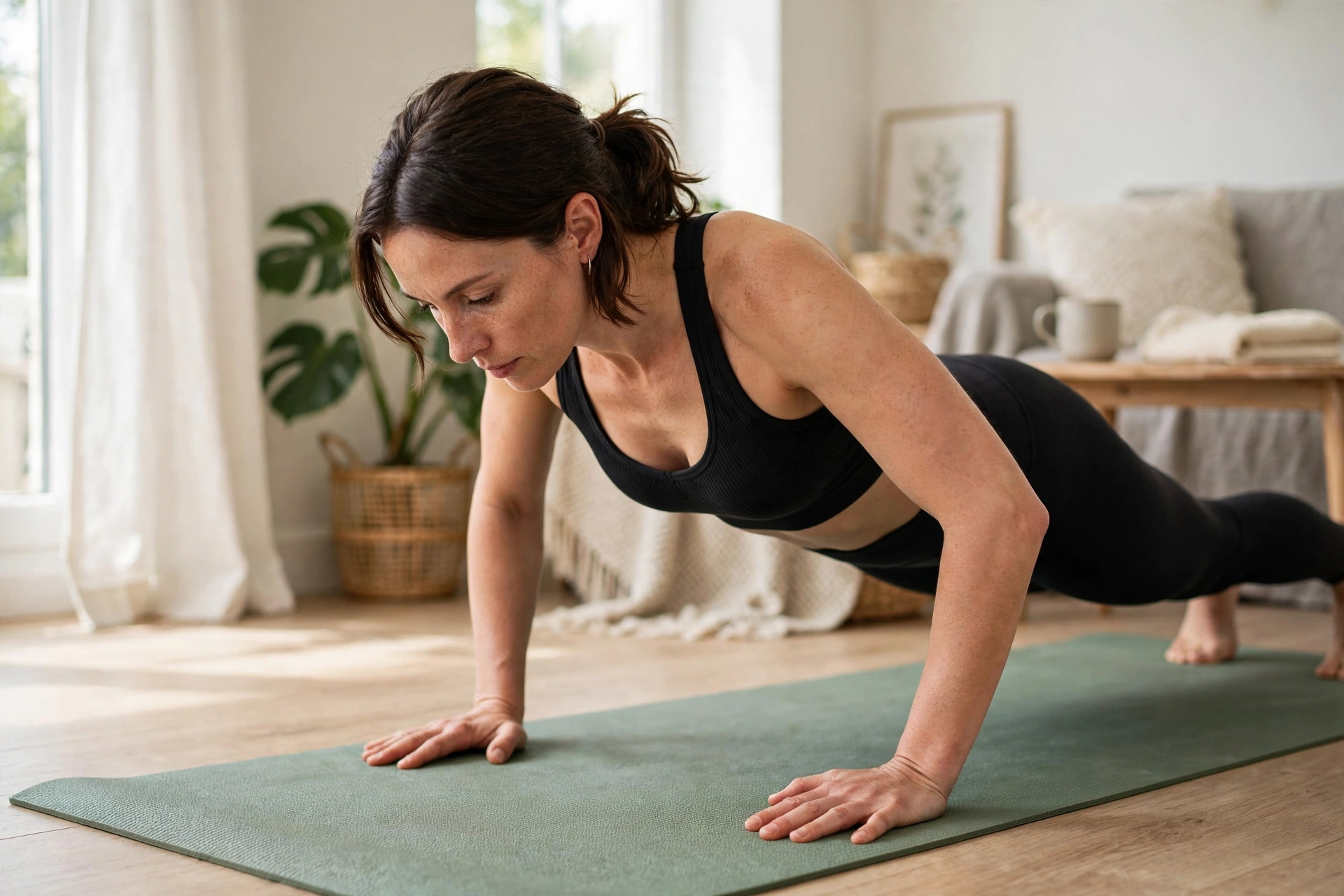
- Knee push-ups or wall push-ups: 8 to 12 reps. Keep a straight line from head to knees, and lower with control.
- Glute bridges: 12 to 15 reps. Press through your heels and squeeze your glutes at the top.
- Bird dogs: 8 reps each side. Move slowly and keep your hips level.
- Dead bugs: 8 reps each side. Press your lower back gently into the floor.
- Standing calf raises: 15 reps. Pause briefly at the top.
Week-by-week guide
| Week | Sessions | Sets per exercise | Focus |
|---|---|---|---|
| Week 1 | 3 | 2 | Learn form, easy effort |
| Week 2 | 3 | 2 to 3 | Add reps or a set |
| Week 3 | 3 to 4 | 3 | Shorter rest, steady effort |
| Week 4 | 3 to 4 | 3 | Try one harder variation |
Cardio finish: 5 to 10 minutes, optional
On Day 3, finish with one of these, at an easy to moderate effort:
- Brisk walking around your home or outside
- Marching in place with arm swings
- Step-ups on a low, sturdy step, alternating legs
- Gentle dance or movement you enjoy
You do not need high intensity to benefit as a beginner. Consistency matters more than exhaustion.
Cool-down: 5 minutes
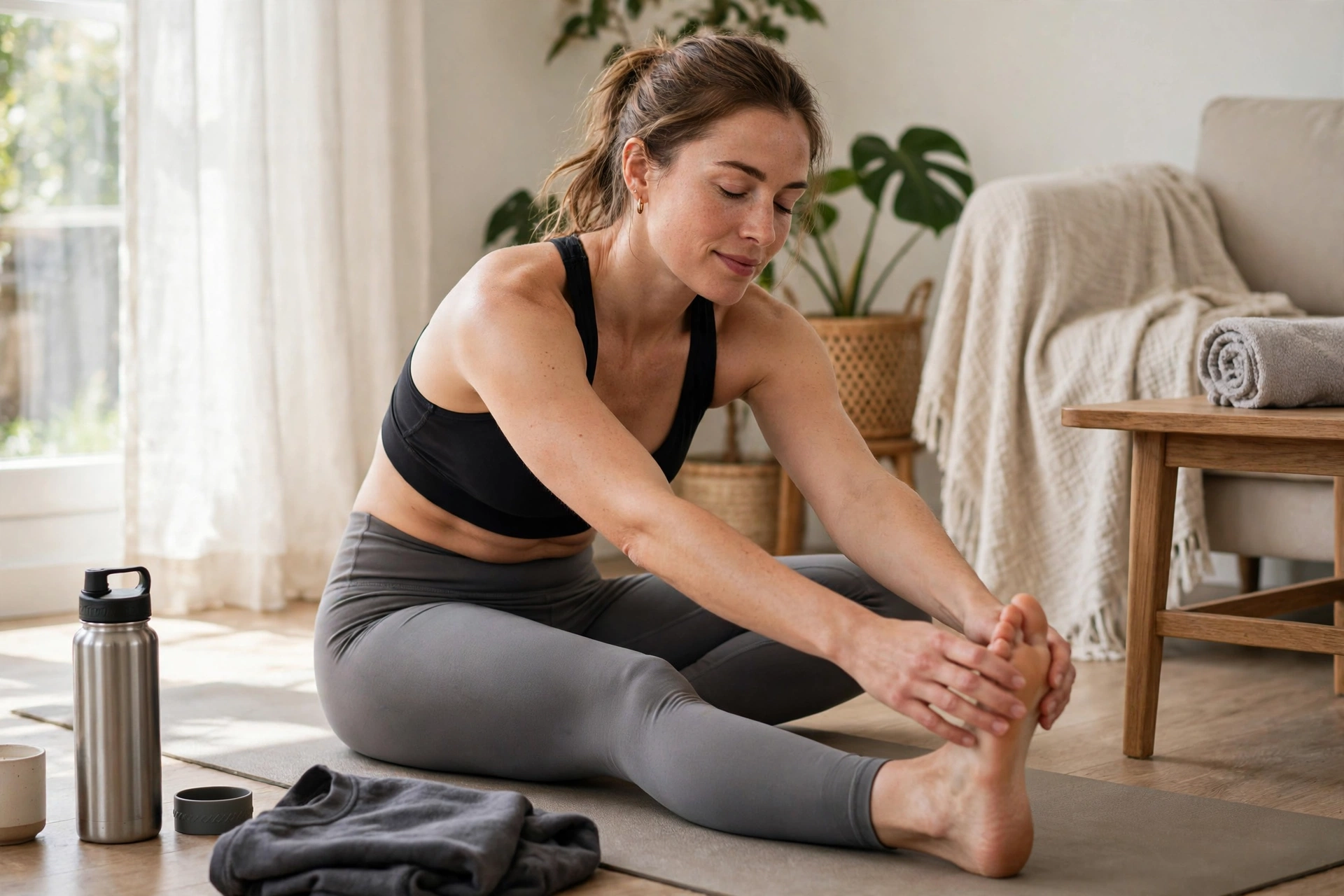
Finish each session with:
- Standing quad stretch, 30 seconds each side, hold a wall for balance if needed
- Hamstring stretch, seated or standing, 30 seconds each side
- Chest opener, hands behind your back, 30 seconds
- Child’s pose or deep breathing, 1 to 2 minutes
Stretching should feel gentle, not painful.
Exercise form in detail: how each move should feel
Good form is what turns a short beginner home workout plan with no equipment into real training. Use this section as a checklist during your first two weeks, then check it again whenever a move starts to feel easy or awkward.
Bodyweight squat
Stand with feet about shoulder width apart, toes slightly out. Sit back as if you are sitting into a chair, keep your chest tall, and let your knees move in the same direction as your toes. Go as low as you can while keeping your heels down and your back flat. If your heels lift, try a slightly wider stance or a smaller range of motion at first. You should feel your thighs and glutes working, not sharp pressure in your knees.
Push-up progression
Start with wall push-ups if full or knee push-ups feel out of reach. Stand an arm’s length from a wall, place your hands at chest height, and lower your chest toward the wall with control. When you can do 15 clean wall push-ups, move to knee push-ups on the floor, keeping a straight line from head to knees. Full push-ups come later, when knee push-ups feel controlled for 12 to 15 reps. A good push-up feels steady in your chest, shoulders, and core, not shaky in your lower back.
Glute bridge
Lie on your back with knees bent and feet flat, about hip width apart. Press through your heels, lift your hips until your body forms a straight line from shoulders to knees, and squeeze your glutes for one second at the top. Do not arch your lower back to lift higher. If you feel it mainly in your hamstrings, move your feet slightly closer to your hips.
Bird dog and dead bug
These core moves are about control, not speed. For bird dogs, start on hands and knees, extend one arm and the opposite leg, and keep your hips level. If your hips rock side to side, shorten the reach. For dead bugs, lie on your back, lift your arms and legs, and lower one arm and the opposite leg while keeping your lower back gently pressed into the floor. If your back arches, do not lower as far. You should feel your deep core working, not your neck straining.
Standing calf raise
Stand tall, hold a wall or chair for balance if needed, and rise onto the balls of your feet. Pause at the top, then lower slowly. Avoid bouncing. A slow lower phase is where much of the benefit comes from, especially for beginners who rush through calf work.
Two sample weeks of this beginner home workout plan: 3-day and 4-day versions
You do not need to train every day. Pick the version that fits your week, and keep it for at least two weeks before changing it.
3-day version
- Monday: Full body circuit, 2 to 3 rounds
- Wednesday: Full body circuit, 2 to 3 rounds, plus a 5 to 10 minute cardio finish
- Friday: Full body circuit, 2 rounds, plus a longer mobility and core session
- Other days: Walking, stretching, or full rest
4-day version
- Monday: Full body circuit, 3 rounds
- Tuesday: Walking and mobility, 20 minutes
- Thursday: Full body circuit, 3 rounds, plus a cardio finish
- Saturday: Full body circuit, 2 rounds, with extra core and stretching
- Other days: Rest or gentle activity
If life gets busy, drop to the 3-day version for a week. That is not failure. It is how you keep the habit alive.
How to track your beginner home workout plan progress without a gym
Tracking does not need an app. A simple note on your phone works, and it helps you see progress that the mirror will not show in Week 1.
Record for each session:
- Date and session type
- Exercises, sets, and reps
- How hard it felt, on a scale of 1 to 10
- Any move that felt awkward or painful, and what you changed
After 4 weeks, compare Week 1 to Week 4. Most beginners see one or more of these: more reps per set, an extra set, a harder variation, shorter rest, or the same workout feeling easier. Those are real results, even if your weight has not changed much.
Also track non-scale wins: better sleep, more energy during the day, less stiffness in the morning, and feeling more confident moving. Those signs often appear before visible changes.
Eating and sleeping around your beginner home workout plan
This is general information, not a diet plan. You do not need a perfect diet to benefit from this beginner home workout plan with no equipment, but a few basics help recovery and energy.
- Eat regular meals, and include a source of protein at most meals, such as eggs, chicken, fish, beans, lentils, tofu, or Greek yogurt, depending on your preferences.
- Drink water through the day, and have water available during training, especially if you train in a warm room.
- Eat a light snack before training if you feel low on energy, and eat a normal meal after training rather than skipping food.
- Prioritise sleep. Beginners often underestimate recovery. Seven to nine hours is a common target for adults, but consistency matters as much as the exact number.
- On rest days, keep moving gently. Walking, light stretching, and normal daily activity support recovery better than sitting all day.
If you have dietary needs, allergies, or a medical condition that affects eating or exercise, get advice from a qualified professional rather than following a generic plan online.
What to do after 4 weeks of this beginner home workout plan
After Week 4, you have three good options, and none of them require a gym:
- Repeat the plan with harder variations. Move from knee push-ups to full push-ups for some sets, add a set, or slow down each rep.
- Add simple equipment, such as resistance bands or a pair of light dumbbells, and keep the same structure.
- Add a second focus, such as a beginner running plan, a yoga session, or a longer walking routine, while keeping 2 to 3 strength sessions a week.
Do not jump straight to an advanced program. The jump from beginner to intermediate is usually gradual, and the safest next step is a slightly harder version of what already worked.
A note for readers in the US, UK, and Canada
The movements in this plan are the same wherever you live. A few practical differences are worth noting:
- In the US, workout clothes are often called athletic wear. In the UK, the same items are often called trainers for shoes and gym kit for clothing. The plan works the same either way.
- Measurements here use minutes, sets, and reps, not pounds or kilograms, because this plan needs no equipment.
- If you train outdoors in Canada or the northern US in winter, warm up indoors first and dress for the cold. If you train in a hot climate in the southern US, train in a cooler part of the day and keep water close.
- Terminology differs, but the principles do not: start easy, progress slowly, rest well, and repeat.
Common beginner home workout plan mistakes to avoid
- Skipping the warm-up. Cold muscles and stiff joints make training feel harder and less safe.
- Doing too much in Week 1. Soreness is normal, but being unable to move for days is a sign you went too far.
- Copying advanced workouts online. A plan built for an experienced lifter is not a beginner plan, even if it looks simple.
- Chasing sweat instead of form. Good form builds strength. Sloppy reps build bad habits.
- Quitting after a missed day. One missed session does not ruin a plan. Just do the next one.
What results can you realistically expect in 4 weeks?
In 4 weeks, most beginners notice:
- Better balance and coordination
- Less breathlessness during everyday activity
- More confidence with basic movements
- Small strength gains, for example more push-ups or squats per set
Visible body changes usually take longer, and they depend heavily on sleep, nutrition, and overall activity. Four weeks is a strong foundation, not a finish line. After this plan, you can repeat it with harder variations, or move to a plan with dumbbells or resistance bands.
How to stay consistent with your beginner home workout plan
- Train at the same time each day, if you can.
- Put your workout clothes out the night before.
- Track your sessions in a notebook or phone note: date, exercises, sets, and reps.
- Choose a backup plan for busy days: a 10-minute walk and one short circuit is better than nothing.
- Pair training with something you enjoy, like music or a podcast.
Frequently asked questions
Do I need equipment to start working out at home?
No. A beginner home workout plan with no equipment can build strength, stamina, and coordination with bodyweight exercises alone. Equipment becomes useful later, when bodyweight work gets too easy, but it is not required to start.
How many days a week should you follow this beginner home workout plan?
Three to four days a week is a good target. That gives you enough practice to improve, with rest days for recovery. More is not always better, especially at the start.
How long should a beginner home workout be?
Twenty to 30 minutes, including warm-up and cool-down, is enough. Short, repeatable sessions beat long sessions you dread and skip.
Will this beginner home workout plan help me lose weight?
Exercise can support weight loss, but nutrition, sleep, and daily activity play a large role too. A consistent home workout plan helps you build muscle, move more, and feel stronger, which supports a sustainable approach to weight management.
What if I cannot do a push-up yet?
Start with wall push-ups, then move to knee push-ups when wall push-ups feel easy. That progression is normal, and it is how most beginners build upper body strength.
Is soreness normal after the first week?
Mild soreness for a day or two is common when you start something new. Sharp pain, joint pain, or soreness that gets worse after several days is different. Ease off, and seek professional advice if you are concerned.
The bottom line
You do not need a gym to get stronger. You need a simple beginner home workout plan with no equipment, good form, and the patience to repeat it for 4 weeks.
Start with Week 1, track your sessions, and add a little effort each week. That is how a beginner home workout plan with no equipment turns into a habit.
Disclaimer: This content is for general information only and is not a substitute for professional medical, fitness, or nutrition advice.

 Ablaze Fitness


