


Tight hips make everything harder. Getting out of a chair feels stiff. Climbing stairs feels heavy. Even a short walk can leave your hips aching by the end of the day. If you sit for most of the day, you are not alone. Tight hips are one of the most common complaints among desk workers, drivers, and runners. The good news is that a short daily routine can loosen them. These hip stretches take ten minutes, need no equipment, and work for most people.
This routine targets the whole hip, not just one muscle. It covers the hip flexors at the front, the glutes and piriformis at the back, and the inner thighs that pull the legs together. You will hold each stretch for 30 to 60 seconds and breathe slowly. Do it once a day, after a walk or a workout, and most people feel a difference within two weeks. This article explains what tight hips are, why they happen, and how to do each stretch with good form. It also covers the mistakes that make hips tighter and the warning signs that mean you should talk to a doctor.
What Tight Hips Actually Feel Like
Tight hips do not always hurt. Often they just feel stiff. You may notice it when you stand up after sitting for an hour. Your first few steps feel short and wooden. You may struggle to cross one leg over the other. Squatting to pick something up can feel awkward. Some people feel a dull ache in the front of the hip or deep in the buttock. Others feel a pinch when they lift a knee. These are all common signs of tight hips.
Tight hips can also show up in other places. Your lower back may ache after a long day at a desk. Your knees may feel sore when you climb stairs. That happens because stiff hips change how you move. When the hips cannot move freely, the lower back and knees take on extra work. Loosening the hips often eases those aches too. That is why hip stretches help more than just the hips.
Why Your Hips Get Tight and Why Hip Stretches Help
Sitting is the main cause. When you sit, the hip flexors stay short and the glutes switch off. Over months and years, the tissues adapt to that short position. They lose length and the hip feels tight when you try to stand up straight. Running can also tighten the hips, especially if you run a lot and never stretch. The hip flexors and the iliotibial band work hard with every step. Without stretching, they stay short and stiff.
Weak glutes make the problem worse. The glutes should power your steps and hold your pelvis steady. When they are weak, the hip flexors and the lower back do more work than they should. That extra work leaves them tight and tired. Stress plays a part too. Many people hold tension in their hips without realising it. A simple daily routine of hip stretches, plus some glute strengthening, breaks the cycle. Our guide to stretches to improve flexibility covers five moves that loosen the whole body.
How This 10-Minute Hip Stretch Routine Works
This routine has seven hip stretches. Each one targets a different part of the hip. Together they cover the front, back, inner, and outer hip. You will hold each stretch for 30 to 60 seconds per side. That is long enough for the muscle to relax. Breathe slowly and never bounce. You should feel a gentle pull, not pain. If a stretch hurts, ease off or skip it.
Do the routine once a day. The best time is after a walk, a workout, or a warm shower, when the muscles are warm. It takes about ten minutes. You can do it on a mat, a rug, or a carpeted floor. Wear clothes you can move in. Keep water nearby. If you are new to stretching, start with 30 seconds per side and build up. Consistency matters more than intensity. A gentle daily routine beats a hard session once a week.
The 7 Hip Stretches in This Routine
Work through the stretches in order. The first three warm up the front and back of the hip. The next three open the inner and outer hip. The last one is a gentle movement that ties the routine together. Hold each stretch for 30 to 60 seconds on each side. Breathe out as you ease into the stretch. If one side feels tighter than the other, give that side a little extra time.
1. Kneeling Hip Flexor Stretch
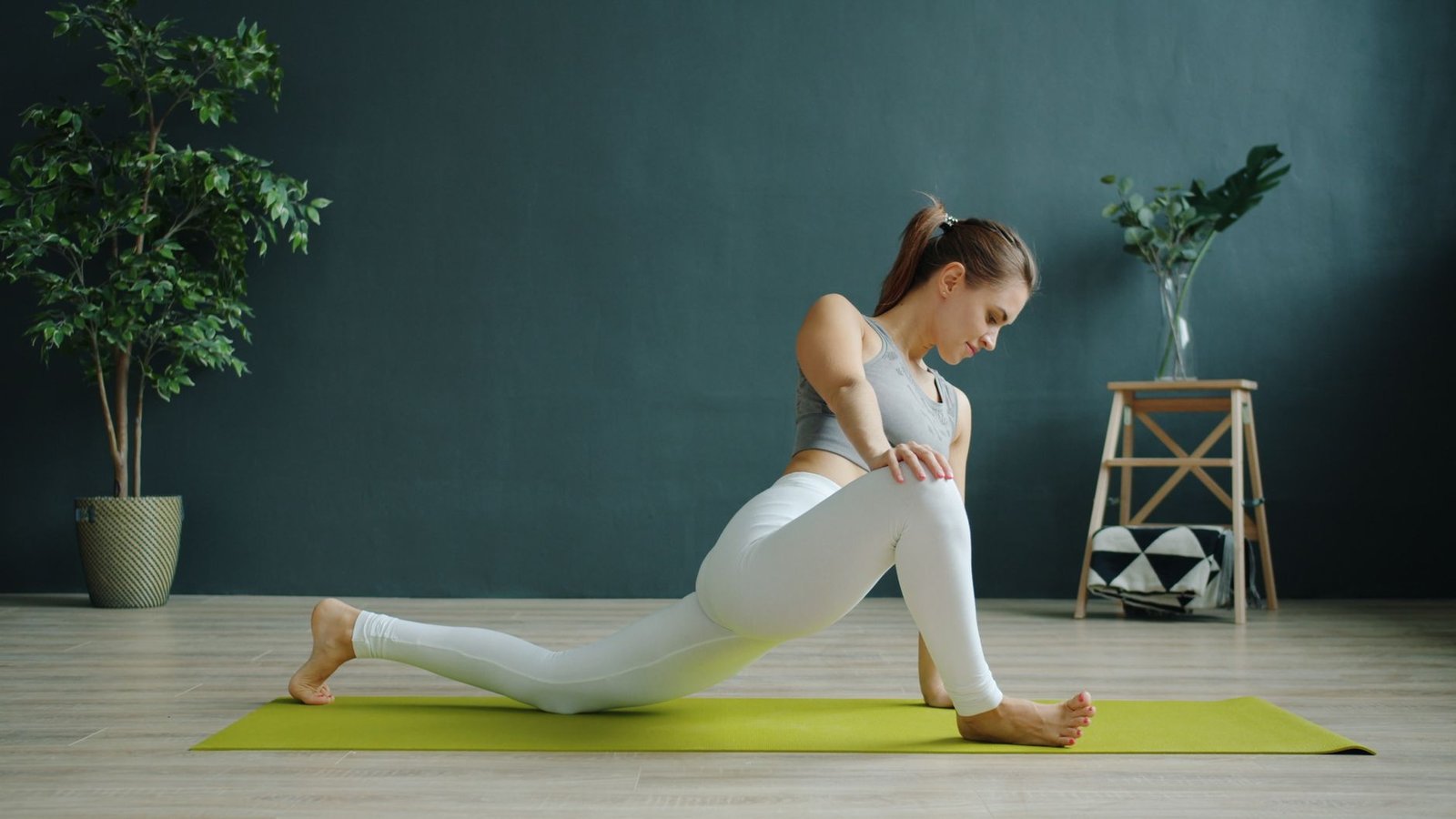
Start on one knee with the other foot flat on the floor in front of you. Keep your chest tall and your hips level. Squeeze the glute of the kneeling leg. Gently shift your weight forward until you feel a stretch at the front of the hip on the kneeling side. Hold for 30 to 60 seconds, then switch sides. Keep your lower back long. Do not arch it.
This stretch targets the hip flexors, the muscles that lift your knee and shorten when you sit. It is the single most useful stretch for desk workers. If the floor hurts your knee, place a folded towel under it. To deepen the stretch, lift the arm on the kneeling side overhead and lean slightly away. Stop if you feel a pinch at the front of the hip.
2. Figure-Four Stretch
Lie on your back with your knees bent and your feet flat. Cross your right ankle over your left knee. Reach through and pull your left thigh toward your chest. You should feel a stretch deep in your right buttock. Hold for 30 to 60 seconds, then switch sides. Keep your head and shoulders relaxed on the floor.
The figure-four stretch targets the piriformis and the deep glute muscles. These small muscles sit close to the sciatic nerve, so tightness here can send an ache down the leg. This stretch is gentle and safe for most people. If you cannot reach your thigh, loop a towel or a belt around it and pull gently. Breathe out as you pull.
3. Pigeon Stretch
Start on all fours. Bring your right knee forward and place it behind your right wrist. Slide your left leg straight back. Lower your hips toward the floor. Keep your hips level. You should feel a deep stretch in your right buttock and outer hip. Hold for 30 to 60 seconds, then switch sides. Rest your forearms on the floor if that feels better.
Pigeon is a strong stretch, so take it slowly. Do not force your hips down. Let gravity do the work. If your knee hurts, place a folded blanket under it. If the stretch feels too intense, try the figure-four stretch instead. It targets the same area with less pressure on the knee. Over time, pigeon becomes easier as the hips open up.
4. Butterfly Stretch
Sit on the floor with the soles of your feet together and your knees out to the sides. Hold your feet with both hands. Sit tall and let your knees drop toward the floor. Do not push them down. Hold for 30 to 60 seconds. Breathe slowly. You should feel a gentle stretch in your inner thighs and groin.
Butterfly targets the adductors, the inner thigh muscles that pull the legs together. These muscles tighten when you sit with your legs crossed or close together. If your knees sit high off the floor, that is normal. Place a cushion under each knee for support. Over weeks, the knees will drop lower as the inner thighs loosen.
5. 90-90 Stretch
Sit on the floor with both knees bent at 90 degrees, one leg in front and one leg behind. Your front shin should point forward and your back shin should point to the side. Sit tall. Lean forward over your front shin until you feel a stretch in the front hip. Hold for 30 to 60 seconds, then switch sides.
The 90-90 stretch works both internal and external hip rotation. Rotation is the movement most people lose first when their hips tighten. It is also the movement that matters most for walking and turning. If you cannot sit upright, place your hands on the floor behind you for support. Do not force the position. A small range is enough to start.
6. Frog Stretch
Start on all fours. Walk your knees wide apart and turn your feet out. Lower your forearms to the floor. Keep your back flat. Gently push your hips back until you feel a stretch in your inner thighs. Hold for 30 to 60 seconds. Breathe out as you sink a little deeper.
Frog is a deep inner thigh stretch. It works the adductors from a different angle than butterfly. Keep your knees in line with your hips and do not let your lower back sag. If the stretch feels too strong, bring your knees closer together. If your knees hurt, place a folded towel under each one. Stop if you feel a sharp pain in the groin.
7. Standing Hip Stretches
Stand tall and hold a wall or a chair for balance. Lift your right knee and draw a slow circle with it, five times in each direction. Then swing your right leg gently forward and back, ten times. Switch sides. Keep the movement slow and controlled. You should feel the hip loosen with each circle.
Standing hip circles are a good way to finish the routine. They add gentle movement after the static holds. They also teach the hip to move freely in all directions. You can use them on their own as a quick desk break. Two minutes of hip circles during a work break can undo an hour of sitting. Try them before a walk to warm the hips up.
How Often Should You Do Hip Stretches?
Once a day is enough for most people. Daily stretching keeps the hips supple and stops tightness from building up. If your hips are very tight, you can do the routine twice a day, morning and evening. Give the muscles at least a few hours between sessions. More is not always better. The tissues need time to adapt.
Pair stretching with strengthening for the best results. Strong glutes support the hips and stop the flexors from overworking. Our guide to hip strengthening exercises for beginners shows seven simple moves that build stable hips. Do them two or three times a week. Walking also helps. Our guide to walking 10,000 steps a day explains how much movement supports hip health. A short walk after each meal keeps the hips moving through the day.
Mistakes That Make Tight Hips Worse
The most common mistake is bouncing. Bouncing triggers a reflex that makes the muscle tighten, which is the opposite of what you want. Hold each stretch still and breathe. Another mistake is holding your breath. Slow breathing helps the muscle relax. If you catch yourself holding your breath, ease off the stretch until you can breathe normally.
Stretching only when it hurts is another mistake. By the time the hips ache, the tightness is already well established. A daily routine prevents the ache. Skipping the warm-up is also a problem. Cold muscles do not stretch well. Walk for five minutes or take a warm shower before you stretch. Finally, do not ignore pain. A gentle pull is normal. Sharp pain is not. If a stretch hurts, stop and try a gentler version.
When to Talk to a Doctor or Physio
Most tight hips improve with stretching. But some symptoms need a professional. See a doctor or a physio if hip pain lasts more than two weeks despite stretching. Also seek help if the hip locks, clicks painfully, or gives way. Numbness or tingling down the leg is another warning sign. So is pain that wakes you at night. These symptoms can point to a joint or nerve problem that stretching alone will not fix.
A physio can check how your hips move and find the cause of the tightness. They may give you specific exercises or hands-on treatment. If your hip pain comes with lower back pain, our article on exercises to relieve lower back pain gives you five gentle moves to try. Do not try to push through sharp pain. A short visit to a physio can save months of guessing. Bring a list of your symptoms and when they started.
How to Fit Hip Stretches Into Your Day
The easiest way to keep the habit is to tie the routine to something you already do. Do it after your morning walk, while the kettle boils, or just before bed. A fixed time removes the daily decision. Put your mat somewhere you can see it. If the mat is rolled up in a cupboard, you will skip more days. Keep it out in the open, and the routine becomes the easy choice.
You do not need special clothes or a quiet room. A clear patch of floor and a cushion for your knees are enough. If you work at a desk, set a reminder to stand and stretch your hips for two minutes every hour. Those short breaks add up through the day. They also stop the hips from stiffening between sessions. A little movement often beats one long session. If your knees ache on hard floors, fold a towel under them.
Track your progress with a simple note. Each week, write down how far your knees drop in butterfly or how long you can hold pigeon without discomfort. Small gains keep you going when motivation dips. After two weeks, most people notice the first clear change. Within a month, the routine often feels like part of the day rather than a chore. That is the point where tight hips stop ruling your schedule. Celebrate the small wins, like standing up without that first stiff step.
Frequently Asked Questions
How long does it take for hip stretches to work?
Most people feel looser after the first session. Lasting change takes longer. Expect two to four weeks of daily stretching before the hips feel clearly different. The exact time depends on how tight the hips were to start with and how often you stretch. Keep a simple note of how far your knees drop in butterfly. That gives you a visible measure of progress.
Can I do hip stretches every day?
Yes. Gentle hip stretches are safe to do every day. Hold each stretch for 30 to 60 seconds and never force it. If the hips feel sore the next day, take a day off or shorten the holds. Stretching should leave you feeling looser, not stiffer. Our post-workout tips explain how to recover well after stretching and exercise.
When to Get Extra Help With Hip Stretches
Do hip stretches help lower back pain?
They can help when tight hips are part of the cause. Stiff hips change how you walk and sit, and the lower back takes on extra work. Loosening the hips often eases that load. Hip stretches are not a cure for back pain. If the pain is severe, lasts more than a few weeks, or comes with numbness, see a doctor. A physio can tell whether your hips are part of the problem.
What if a hip stretch hurts?
Stop the stretch. A gentle pull is normal, but sharp pain is a warning. Ease off until the pain fades. If it still hurts, skip that stretch and try a gentler one. Pain that lasts more than a day after stretching needs a doctor. Do not stretch through it. The goal is to loosen the hips, not to win a flexibility contest.
This article is for general information only. It is not medical advice. Hip stretches suit most people, but they are not right for everyone. If you have a hip injury, arthritis, or a recent surgery, talk to a doctor or a physio before you start a new stretching routine. Stop any stretch that causes sharp pain. If symptoms persist or get worse, seek professional care.

 Ablaze Fitness


 Mélanie Courcelles


